
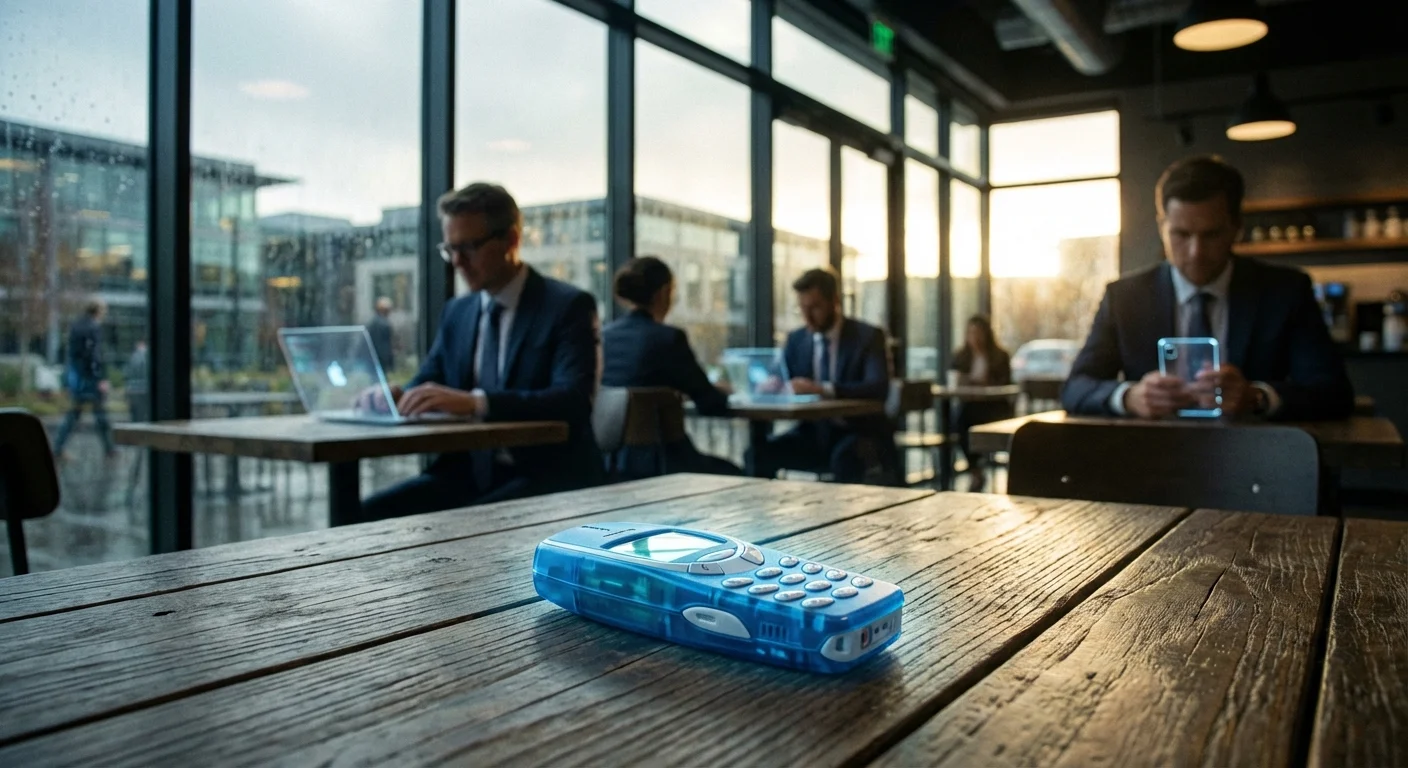
Picture this: You walk into a high-end, minimalist coffee shop in the heart of Silicon Valley. Around you, venture capitalists and startup founders are intensely focused on glowing screens, tapping away on the latest thousand-dollar smartphones. But then, a top-tier tech executive in a tailored suit reaches into his pocket, and instead of pulling out a sleek, titanium-framed smartphone, he flips open a chunky, plastic $50 Nokia phone from 2008. He checks a text, snaps it shut with a satisfying ‘clack,’ and goes back to his espresso. This isn’t a scene from a retro comedy movie; it is a rapidly growing reality. Welcome to the ‘Dumb Phone’ movement.
The Paradox of the Creators Escaping Their Creations
For over a decade, the narrative has been clear: newer, faster, and more connected is always better. We have essentially attached supercomputers to our hands, giving us instant access to the entirety of human knowledge, global communication, and endless entertainment. Yet, the very architects of these digital ecosystems are quietly backing out. Why are the people who built our addictive digital world suddenly running away from it?
The answer lies in the concept of the ‘attention economy.’ Tech insiders know better than anyone how smartphones and social media algorithms are engineered. They are acutely aware that these platforms utilize the same psychological hooks as slot machines. The ‘infinite scroll’ and the unpredictable ping of notifications are based on B.F. Skinner’s behavioral principle of variable-ratio reinforcement. This keeps the brain in a constant state of low-grade anxiety and dopamine anticipation. Realizing the devastating toll this takes on deep thinking, creativity, and mental health, many tech executives are taking drastic measures to reclaim their cognitive autonomy.
What Exactly is a ‘Dumb Phone’?
A ‘dumb phone’ (often referred to politely as a feature phone) is a mobile device that strips away the internet-heavy features of a smartphone. While a modern smartphone is fundamentally a portable entertainment and work terminal that happens to make calls, a dumb phone is explicitly designed for telecommunications. It makes phone calls. It sends SMS text messages. It might have an alarm clock, a basic calculator, and perhaps a pixelated version of Snake. That is it.
The dumb phone movement isn’t just about nostalgia, though that plays a part for Gen Z adopters who love the Y2K aesthetic. For professionals, it is a calculated productivity hack. Without a web browser, social media apps, push email notifications, or a high-definition screen designed to steal your gaze, a dumb phone becomes a purely utilitarian tool rather than a digital companion.
The Heavy Toll of the Smartphone Era
To understand the appeal of the dumb phone, we must acknowledge the invisible weight of the smartphone. The average person taps, swipes, and clicks their smartphone over 2,600 times a day, with screen time often exceeding five to seven hours. This constant state of connectivity has resulted in an epidemic of digital fatigue, reduced attention spans, and soaring rates of anxiety.
Cal Newport, the author of Digital Minimalism, argues that human beings are not wired to be constantly tethered to a global network of information and social validation. The constant influx of data prevents our brains from entering the ‘default mode network,’ a neurological state of rest where daydreaming, problem-solving, and deep creativity occur. By downgrading to a dumb phone, individuals are forcibly introducing friction into their digital lives, making it harder to waste time and easier to be present in the physical world.
Smartphones vs. Dumb Phones: A Modern Comparison
Let us look at a direct comparison between the two devices to understand the lifestyle shift involved.
| Feature | Modern Smartphone ($1,000+) | Classic ‘Dumb Phone’ ($50) |
|---|---|---|
| Core Function | Entertainment, internet, social media, photography, email | Voice calls, SMS texting |
| Battery Life | Requires daily charging, sometimes twice a day | Lasts for 5 to 14 days on a single charge |
| Durability | Fragile glass screens, requires expensive cases | Highly durable plastic, can survive major drops |
| Distraction Level | High (Constant notifications, infinite scrolling) | Zero (No apps to check) |
| Mental Impact | FOMO, anxiety, disrupted sleep cycles from blue light | Presence, improved focus, mental clarity |
Reclaim Your Brain’s Natural Focus
If downgrading to a flip phone feels too extreme, you can still optimize your mental clarity and retrain your focus using advanced brainwave audio technology.
How to Join the Dumb Phone Movement (Without Ruining Your Life)
Going ‘dumb’ in a hyper-smart world is not without its challenges. Today’s society is built around the smartphone. We need apps to scan restaurant menus, board airplanes, authenticate bank logins, and navigate unfamiliar cities. So, how are tech executives navigating these hurdles? They use a hybrid approach.
Step 1: The ‘Companion Device’ Strategy
Many digital minimalists do not throw their iPhones in the trash. Instead, they relegate the smartphone to the status of a ‘home computer’ or a ‘tool.’ They might keep an iPad or a smartphone in their backpack or home office for specific tasks like checking emails or hailing an Uber. However, the device they carry in their pocket when they go for a walk, attend a dinner, or spend time with family is the dumb phone. This creates intentional friction: you can still access the internet if you absolutely need to, but you can’t mindlessly pull it out of your pocket at a red light.
Step 2: Premium Minimalist Phones
If a $50 plastic flip phone doesn’t appeal to you, the tech market has responded with ‘premium dumb phones.’ Devices like the Light Phone II and the Punkt MP02 offer beautiful, minimalist designs. They use e-ink displays (like a Kindle) so they are easy on the eyes, and they strip away everything except calls, texts, alarms, and occasionally a basic maps or podcast tool. They cost a bit more, but they offer a sleek bridge between extreme disconnection and modern aesthetics.
Step 3: ‘Dumbing Down’ Your Current Smartphone
If you cannot afford a second device or simply cannot give up WhatsApp or Google Maps for work, you can turn your current smartphone into a dumb phone. This involves deleting all social media and news apps, turning the screen to grayscale (which immediately makes the phone less appealing to your brain), and disabling all notifications except for phone calls and calendar events. It requires more willpower, but it is an excellent first step.
The Surprising Benefits of Reconnecting with Reality
Those who have successfully made the switch report life-changing benefits. Without the constant barrage of breaking news and curated social media feeds, underlying anxiety levels plummet. Sleep quality improves dramatically without late-night blue light exposure and doomscrolling. Most importantly, users report a sudden return of deep, sustained focus. Without the ability to escape into a screen during moments of boredom, individuals find themselves engaging in deeper conversations, reading actual books, and noticing the world around them.
Boredom is not the enemy; it is the birthplace of brilliant ideas. When tech executives trade their iPhones for flip phones, they are not taking a step backward in time; they are taking a step forward in reclaiming their cognitive potential. In an economy where attention is the most valuable commodity, the ultimate status symbol is no longer the most expensive smartphone. The ultimate status symbol is the luxury of being unreachable.
Frequently Asked Questions (FAQ)
Can I still use WhatsApp or Spotify on a dumb phone?
Traditional dumb phones do not support modern apps like WhatsApp or Spotify. However, there is a middle-ground category known as ‘smart feature phones’ (like those running KaiOS, such as the Nokia 2780). These devices have tactile keypads but offer basic versions of WhatsApp, Google Maps, and YouTube. Premium minimalist devices like the Light Phone II offer a basic podcast tool but avoid social messaging apps.
How do I handle navigation and Google Maps?
Many people who switch to dumb phones buy a standalone GPS unit for their car, like a Garmin. Others plan their routes on a computer before leaving the house and write down the directions—a surprisingly effective cognitive exercise. Alternatively, you can keep a smartphone in your glovebox specifically for navigation.
What are the most popular dumb phones right now?
The most popular choices include the classic Nokia 225 4G, the TCL Classic Flip, the Punkt MP02, and the Light Phone II. The choice depends on whether you want a cheap, indestructible retro phone or a beautifully designed, modern minimalist tool.
Will I miss out on important work emails?
The goal of the dumb phone movement is not to stop working, but to compartmentalize work. By removing email from your pocket, you force yourself to check email intentionally at a computer. Most executives find that setting specific times to check email on a laptop actually increases productivity and drastically reduces off-hours stress.
Is this just a passing trend?
While the aesthetic appeal among Gen Z might ebb and flow, the psychological shift is likely here to stay. As society becomes increasingly aware of the mental health impacts of screen time, digital minimalism will continue to grow as a necessary counter-culture movement against the attention economy.