
India’s Latest Union Budget 2026: A Vision for Growth and Competitiveness
Here’s a blog on the Latest Budget of India 2026 (Union Budget 2026–27) in up to 300 words:
India’s Latest Union Budget 2026: A Vision for Growth and Competitiveness
On 1 February 2026, Finance Minister Nirmala Sitharaman presented the Union Budget 2026–27 in Parliament — her ninth consecutive budget — aiming to accelerate India’s economic growth, strengthen infrastructure, and boost domestic manufacturing.

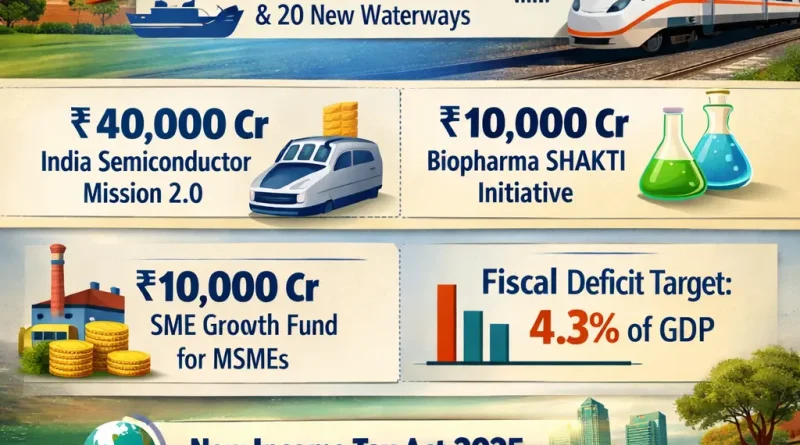
A standout feature of the budget is the record increase in capital expenditure (capex) to ₹12.2 lakh crore, underscoring the government’s commitment to infrastructure-led growth. Major projects include seven new high-speed rail corridors, 20 additional national waterways, and a Dedicated Freight Corridor linking eastern and western India to enhance cargo movement and logistics efficiency.
India’s push towards self-reliance gets a strong boost through targeted programmes such as the India Semiconductor Mission 2.0 with an outlay of ₹40,000 crore and the Biopharma SHAKTI initiative, allocating ₹10,000 crore to position India as a global biopharmaceutical hub. The budget also prioritises the MSME sector with a ₹10,000 crore SME Growth Fund to support small and medium enterprises.
Fiscal discipline remains a priority, with the fiscal deficit targeted around 4.3% of GDP for 2026–27, maintaining a balance between growth and prudence.
For taxpayers, the new Income Tax Act, 2025 is set to take effect from April 1, 2026, simplifying compliance and reducing complexities. While income tax slabs remain largely unchanged, revisions include tax incentives for foreign firms using Indian data centres and reduced TCS on overseas education, travel, and medical remittances.

Overall, the Budget 2026 aligns with the government’s long-term goal of Viksit Bharat 2047, focusing on infrastructure, technology, manufacturing and inclusive growth — balancing short-term needs with long-term economic resilience.