
The Breaking Point: Why I Ditched My Smartphone
It was 2:14 AM on a Tuesday. My eyes were bloodshot, my thumb was numb, and I was deep down a TikTok rabbit hole about competitive dog grooming—a topic I care absolutely nothing about. Meanwhile, my work Slack was pinging in the background, unread emails were piling up, and a heavy, suffocating feeling rested on my chest. I was completely, undeniably burned out.
We hear the word ‘burnout’ thrown around a lot. For me, it didn’t mean I was physically exhausted; it meant my brain felt like a browser with 150 open tabs, and the music was playing, but I couldn’t figure out where it was coming from. I tried meditation apps, productivity hacks, and even weekend retreats. Nothing worked. The moment I returned to my screen, the anxiety spiked.
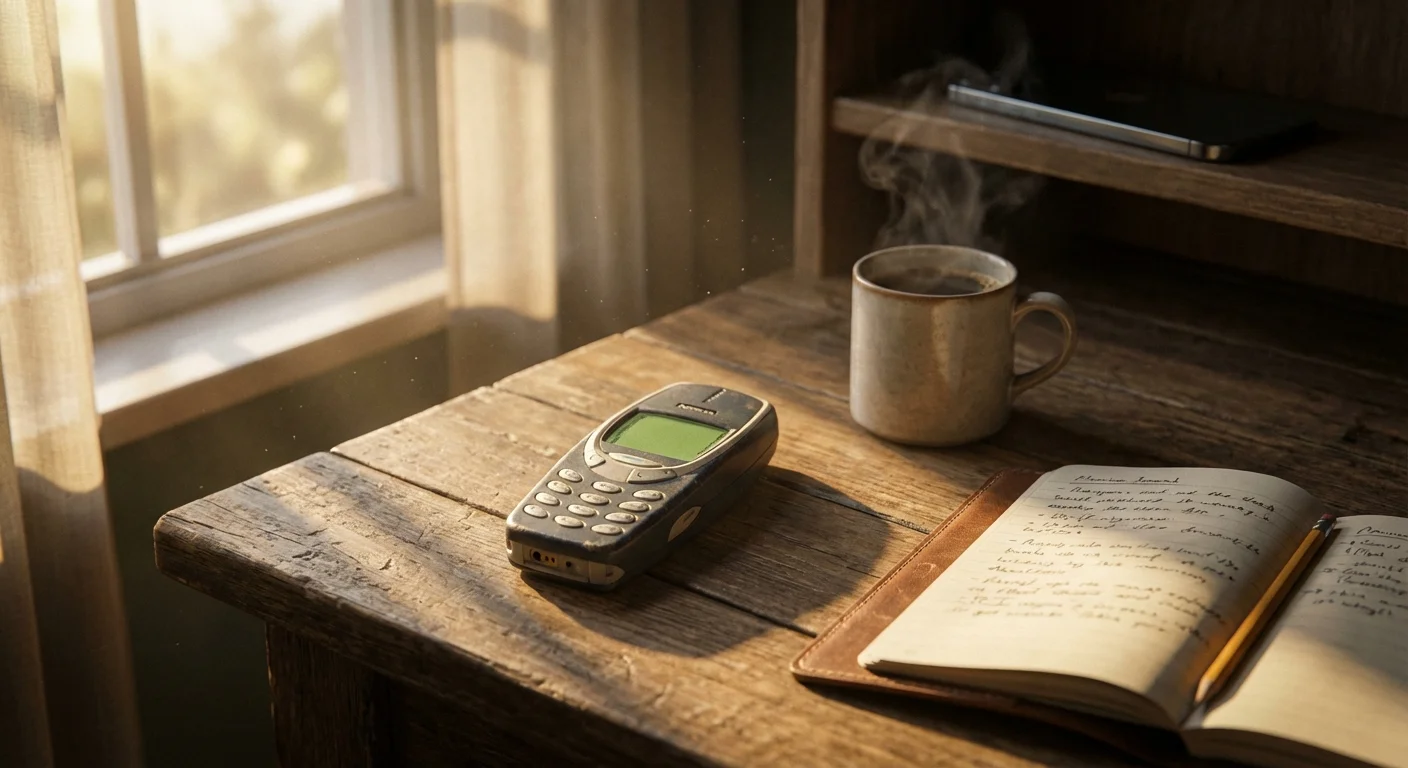
That’s when I had a radical thought: What if the tool I was using to ‘manage’ my life was actually the thing destroying it? The next morning, I drove to a local electronics store, bought a $35 basic flip phone (a ‘dumb phone’), took my SIM card out of my $1,200 smartphone, and committed to 30 days of digital minimalism. What followed was a painful, eye-opening, and ultimately life-changing experiment.
The Preparation: Setting the Rules of Engagement
You can’t just drop off the digital map without warning in the modern world. Before starting my 30-day dumb phone challenge, I had to set some ground rules to ensure I didn’t get fired or cause my family to file a missing persons report.
- Rule 1: No smartphone use for any reason. My iPhone was powered down and locked in a desk drawer.
- Rule 2: Desktop computers are for work only. I could use my laptop from 9 AM to 5 PM for emails, Zoom calls, and essential tasks. After 5 PM, the laptop was closed.
- Rule 3: Cash and physical cards only. No Apple Pay, no scanning QR codes for menus.
- Rule 4: Navigation by preparation. If I needed to go somewhere new, I had to look up the directions on my computer beforehand and write them down on a Post-it note.
With my contacts transferred to my new plastic brick and my family warned that I would now be texting via T9 predictive text, the experiment began.
Week 1: The Agony of the ‘Phantom Buzz’
If you think you aren’t addicted to your smartphone, try leaving it in another room for 24 hours. The first week was pure, unadulterated withdrawal. I realized my smartphone wasn’t just a communication device; it was an adult pacifier.
Standing in line at the grocery store felt agonizingly awkward. Without a screen to stare at, I had to just… stand there. I noticed how everyone else was hunched over their glowing rectangles. I felt a bizarre sense of isolation, combined with a persistent, nagging anxiety that I was missing something critical.
The strangest phenomenon was the ‘phantom buzz.’ At least ten times a day, I felt a vibration in my pocket and instinctively reached down, only to remember my dumb phone was sitting silently on the table. My brain had been rewired to anticipate constant digital stimulation, and without it, my nervous system was misfiring.
Week 2: The Shift and The Return of Time
Around day 10, the fog began to lift. The compulsive need to reach into my pocket slowly faded, replaced by a shocking realization: the days felt incredibly long. Without the ability to lose 45 minutes to an Instagram reel loop, I suddenly had an abundance of free time.
I started reading books again. Not listening to audiobooks while multitasking, but sitting on my couch with a physical paperback, reading for two hours straight. My attention span, which I feared was permanently fractured, began to knit itself back together. Sleep was the most dramatic improvement. Because I wasn’t doomscrolling in bed, I was falling asleep in ten minutes instead of an hour. I woke up feeling rested, a sensation I hadn’t experienced in years.
Week 3 & 4: Deep Focus and The End of Burnout
By the third week, the burnout that had plagued me for months was practically gone. The constant, low-grade anxiety that accompanied my smartphone—the feeling that I should be responding to an email, checking a news alert, or updating a status—evaporated.
My productivity at work skyrocketed. Because I knew I couldn’t check my emails on the couch at 8 PM, I became hyper-efficient during my working hours. I tackled deep, complex tasks that I had been procrastinating on for weeks. I was present during conversations with my partner. I noticed the weather. I felt like I had woken up from a strange, digital matrix.
Supercharge Your Focus & Beat Brain Fog
If you’re looking to reset your brain, reduce stress, and reclaim your attention span without completely ditching your smartphone, try optimizing your brainwaves with targeted audio frequencies.
Smart vs. Dumb: The Data Behind My 30-Day Experiment
I tracked several personal metrics during the 30 days to see if the qualitative changes matched the quantitative data. The results were staggering.
| Metric | Before (Smartphone) | After (Dumb Phone) |
|---|---|---|
| Daily Screen Time (Mobile) | 5 hours 42 minutes | 18 minutes |
| Average Hours of Sleep | 5.5 hours | 7.5 hours |
| Books Read in a Month | 0 | 4 |
| Self-Reported Anxiety Level (1-10) | 8/10 | 3/10 |
| Times Checking Work Email Post-5 PM | 12+ times | 0 times |
5 Life-Changing Lessons from 30 Days Offline
Downgrading to a dumb phone taught me more about my own psychology than years of therapy. Here are the five most profound lessons I took away from the experiment:
1. Almost Nothing is Truly Urgent
We’ve created a culture of false urgency. Over the entire 30 days, I didn’t miss a single true emergency. The world did not end because I replied to an email at 9 AM the next day instead of 10 PM that night.
2. Boredom is a Catalyst for Creativity
Smartphones have eradicated boredom. But boredom is essential. It’s the brain’s resting state, the blank canvas where new ideas are formed. When I allowed myself to be bored while waiting for a train, my mind wandered, and I found myself solving complex work problems naturally.
3. The ‘Convenience’ Trap is an Illusion
Smartphones are incredibly convenient. But the price of that convenience is our attention. Yes, looking up a recipe in three seconds is easy, but if you end up scrolling TikTok for an hour afterward, the convenience wasn’t worth the cost.
4. Presence is the Ultimate Luxury
Giving someone your undivided attention without a phone sitting face-up on the table is one of the most powerful ways to show respect and love. The depth of my conversations improved dramatically when there was no digital escape hatch available.
5. Burnout is Often Just Cognitive Overload
My burnout wasn’t caused by working too many hours; it was caused by never fully unplugging. The brain needs off-hours to recover. A dumb phone enforced those boundaries.
The Verdict: Am I Going Back to a Smartphone?
Day 31 arrived, and I stared at my iPhone in the desk drawer. Did I turn it back on? Yes. The modern world is built around smartphones, and navigating society without one—from mobile banking to digital plane tickets—is highly impractical.
However, my relationship with my smartphone is forever changed. I stripped it of all social media apps, turned off every notification except phone calls and texts from immediate family, and instituted a strict ‘phone goes in the drawer at 6 PM’ rule. The dumb phone still sits on my desk, fully charged. It serves as my weekend device. If I’m going to the park, out to dinner, or spending time with family, the smartphone stays home. I survived the 30 days, cured my burnout, and proved to myself that I control the technology, not the other way around.
Frequently Asked Questions (FAQ)
How did you navigate without Google Maps?
This was the hardest part. I had to revert to looking up directions on my laptop before leaving the house and writing them down. Interestingly, this improved my spatial awareness and memory. I actually learned the layout of my city instead of blindly following a blue dot.
What about listening to music or podcasts?
I dug out an old MP3 player I found in my closet and loaded it with downloaded music and a few podcasts. It took more effort to sync, but it completely eliminated the distraction of incoming notifications while I was listening.
Did your friends and family get annoyed?
Initially, yes. Texting me was a chore because my replies were short (T9 texting is slow). Group chats were completely ignored. However, after a week, my true friends adapted. Instead of sending me ten small texts, they started actually calling me. I had more meaningful phone conversations in that month than I had in the previous year.
Is a digital detox realistic for someone who relies on their phone for work?
It depends on your job, but mostly yes. You can communicate with your team that you are only available via Slack or email on your desktop during specific hours. Most ‘mobile emergencies’ are manufactured. Setting boundaries might feel uncomfortable at first, but it commands respect and drastically improves your mental health.
Which dumb phone do you recommend for this experiment?
Any cheap phone that can only call and text will work. The Nokia 225 4G or the Light Phone II (which is a bit pricier but features an elegant E-ink display) are great options. The goal isn’t to buy a fancy minimalist device; the goal is to break the dopamine loop.