
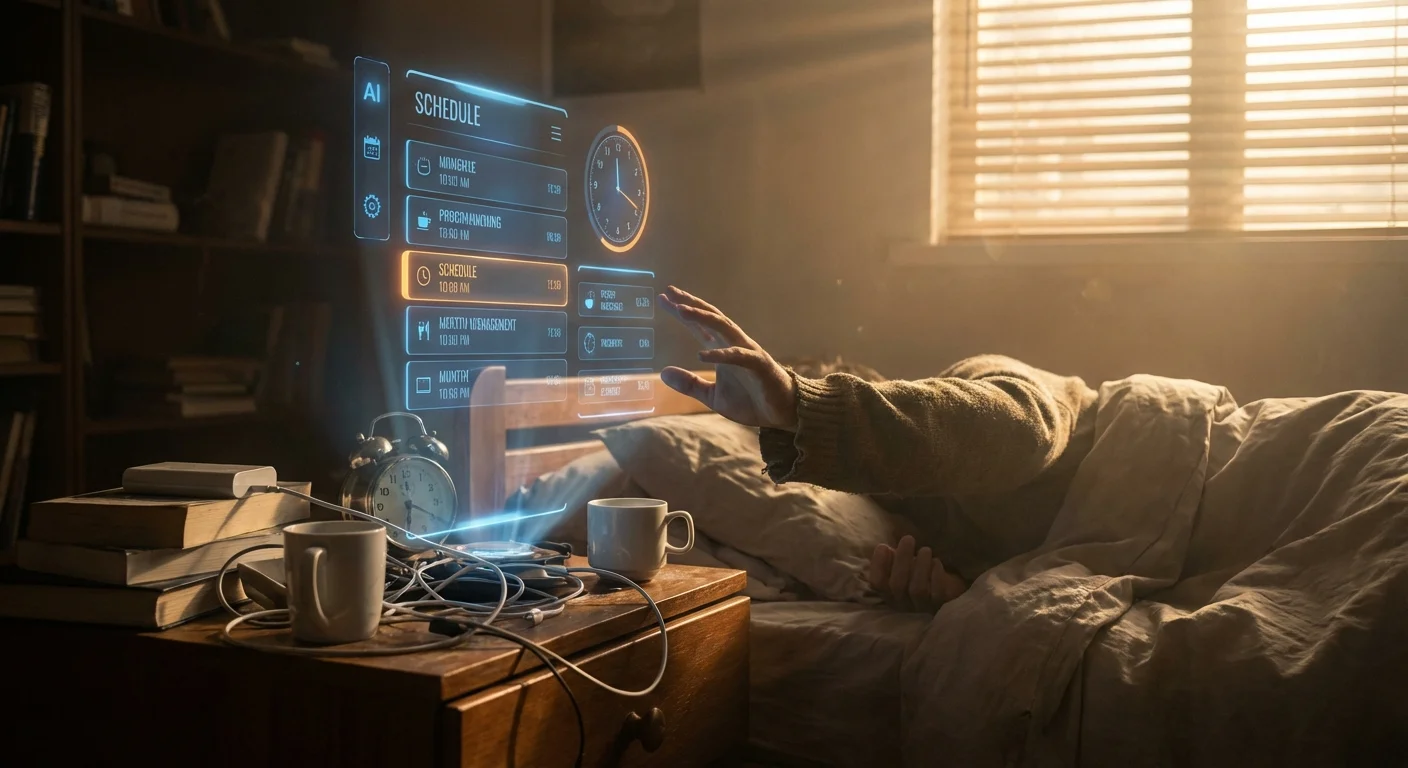
We have all been there. The alarm goes off at 6:30 AM, and despite your best intentions the night before, your hand instinctively slams the snooze button. Thirty minutes later, you are frantically scrolling through emails with one eye open, chugging lukewarm coffee, and already feeling like you are behind on a day that has barely started.
For years, this was my reality. My morning routine was a chaotic symphony of stress and reactive behavior. I had tried every self-help guru’s morning protocol—the 5 AM Club, the cold plunges, the manifestation journals—but nothing stuck. Human willpower is notoriously fragile, especially before the sun comes up.
That is when I had a wild, slightly dystopian idea: What if I removed human willpower from the equation entirely?
What if I let an Artificial Intelligence dictate exactly what I did for the first three hours of my day? No arguing, no snoozing, no second-guessing. Just me, blindly following the commands of a machine learning model. I decided to run the experiment for seven days. I expected it to be a rigid, robotic nightmare. Instead, the results were terrifyingly good.
The Setup: Programming My AI Overlord
AI is only as intelligent as the data you feed it. To create my algorithmic drill sergeant, I could not just ask ChatGPT for a generic “good morning routine.” I needed hyper-personalization.
I opened my preferred AI assistant and fed it a massive prompt containing highly specific data about my life. I gave it my sleep-wake cycles, my dietary restrictions, my fitness goals, my daily work schedule, and my worst morning habits (hello, doomscrolling). I also gave it a specific objective: Optimize my biology and psychology for maximum focus and minimal stress by 9:00 AM.
The AI thought for a few seconds and spat out a meticulously timed schedule. It did not look like the typical “wake up and hustle” tech-bro routine. It was grounded in neurobiology, circadian rhythms, and behavioral psychology. Here is the exact schedule it generated for me:
- 6:00 AM: Immediate wake-up. No snooze. Do not look at notifications.
- 6:05 AM – 6:15 AM: “Photonic Reset.” Go outside and stare in the general direction of the sun (not directly at it) to trigger cortisol release and halt melatonin production.
- 6:15 AM – 6:30 AM: Hydration protocol. Drink 16oz of water with a pinch of sea salt and lemon. No coffee yet.
- 6:30 AM – 6:50 AM: Dynamic movement (not a full workout, just mobility flow) to elevate core body temperature.
- 6:50 AM – 7:00 AM: Contrast shower (3 minutes hot, 1 minute freezing cold).
- 7:00 AM – 7:30 AM: “Strategic Silence.” No input. No music, no podcasts, no talking. Just writing down three core objectives for the day.
- 7:30 AM: First caffeine intake (delayed 90 minutes after waking to prevent the afternoon crash).
It was incredibly specific. It was also deeply intimidating. But I had committed to the bit. I set my alarm for 6:00 AM and went to sleep.
Days 1 to 2: The Shock to the System
Day 1 was a masterclass in psychological resistance. When the alarm blared at 6:00 AM, every fiber of my being wanted to rebel against the machine. The thought of stepping outside into the crisp morning air to stare at the sky felt absurd. But the rules were the rules.
The “Photonic Reset” was bizarrely effective. Within five minutes of being outside, the grogginess began to lift. However, the real challenge was the delayed caffeine. I am used to reaching for a mug of coffee like a lifeline the moment my feet hit the floor. The AI forcing me to wait 90 minutes felt like a cruel form of algorithmic torture.
The contrast shower was equally brutal. The AI specifically noted that cold water exposure increases dopamine by up to 250% for several hours. As I stood shivering under the freezing water, I cursed the language model that suggested this. But when I stepped out? I felt electric.
By 9:00 AM on Day 2, I noticed something strange. My usual underlying hum of morning anxiety was gone. Because I was simply following a script, I experienced zero decision fatigue. I did not have to negotiate with myself about when to shower, what to do first, or when to drink coffee. The AI had removed the friction of choice.
Days 3 to 5: The Breakthrough
By the third day, the routine stopped feeling like a punishment and started feeling like an unfair advantage. This was when the science behind the AI’s choices really began to manifest.
Delaying my caffeine intake by 90 minutes completely eradicated my notorious 2:30 PM energy crash. By allowing my natural cortisol to spike and clear out adenosine (the sleep-inducing chemical) before introducing caffeine, I was experiencing a smooth, sustained burn of energy rather than a chaotic spike and fall.
The “Strategic Silence” block became my favorite part of the day. In our hyper-connected world, waking up and immediately flooding our brains with the thoughts, emails, and demands of other people puts us in a reactive state. By enforcing 30 minutes of zero input, the AI forced me into a proactive state. I was setting the terms of my day before the world could set them for me.
My productivity during my morning work blocks skyrocketed. The brain fog that usually lingered until 10:00 AM was entirely gone. I was sitting down at my desk at 8:00 AM sharp, fully caffeinated, biologically optimized, and ruthlessly focused.
The Data: Before AI vs. After AI
As a data nerd, I tracked my metrics using my wearable fitness tracker and a productivity app. The numbers over just seven days were staggering.
| Metric | Pre-AI Routine | AI-Controlled Routine |
|---|---|---|
| Average Wake Time | 7:15 AM (after 2 snoozes) | 6:00 AM (0 snoozes) |
| Time to First Phone Unlock | 2 minutes | 90 minutes |
| Morning Deep Work Logged | 45 minutes | 2.5 hours |
| Perceived Afternoon Crash | Severe (Required 2nd coffee) | Non-existent |
The AI had successfully hacked my biology better than I ever could on my own. It didn’t just give me a list of tasks; it sequenced them in a way that leveraged my natural physiological responses.
Automate Your Life with 100+ AI Assistants
If you are ready to stop wasting time and let AI optimize your workflow, productivity, and business just like it optimized my mornings, this elite bot bundle is a total game-changer.
Days 6 to 7: Terrifyingly Good Optimization
By the final days of the experiment, I experienced a paradigm shift. I realized that my previous struggles with morning routines weren’t due to a lack of discipline; they were due to decision fatigue and poor biological timing.
We spend so much mental energy trying to “motivate” ourselves to do the right things. But motivation is a fleeting emotion. The AI didn’t care about my motivation. It only cared about execution. By treating the AI’s schedule as an immutable law of physics, I bypassed my brain’s natural tendency to negotiate.
What was terrifying wasn’t the routine itself; it was the realization of how easily a machine could optimize a human being. The algorithm understood my dopamine pathways, my adenosine buildup, and my circadian rhythms better than I did. It knew exactly which levers to pull to generate a state of peak performance.
The 3 Key Lessons I Learned
After seven days of algorithmic servitude, I emerged with three profound realizations that will permanently change how I structure my days.
1. Outsource Your Willpower
Decision fatigue is the enemy of progress. If you wake up and have to decide whether to work out, what to eat, or when to start working, you are already draining your cognitive battery. By outsourcing those decisions to an AI (or simply writing them down the night before), you preserve your mental energy for the actual work.
2. Sequence Matters More Than Ingredients
I was already doing some of the things the AI suggested (drinking water, having coffee, showering). But the sequence changed everything. Delaying coffee, getting sunlight before screens, and using cold water for a dopamine spike created a cascading effect of focus. It is not just about what you do; it is about when you do it.
3. The Power of ‘Strategic Silence’
We are a society addicted to input. Waking up and immediately checking social media or the news trains your brain to expect rapid-fire dopamine hits, which destroys your attention span for the rest of the day. Reclaiming the first hour of your day for silence and output is the ultimate productivity hack.
Conclusion: Will I Keep My AI Overlord?
The seven-day experiment is over, but I am not going back to my old ways. The AI-controlled morning routine was so terrifyingly effective that it has become my new normal. I have tweaked it slightly—giving myself a bit more grace on the weekends—but the core structure remains intact.
If you are struggling to find your footing in the mornings, I highly recommend trying this. Strip away the excuses, feed your data into an AI, and blindly follow its instructions for just one week. You might just find that giving up control is the ultimate way to get your life back together.
Frequently Asked Questions (FAQ)
How exactly do I prompt an AI to create a morning routine?
Be extremely specific. Tell the AI your current wake-up time, your desired wake-up time, your energy levels throughout the day, your diet, and your ultimate goals (e.g., deep work, fitness, reduced stress). Ask it to sequence the routine based on circadian rhythms and neurobiology rather than just a to-do list.
Is it safe to delay caffeine by 90 minutes?
Yes, and it is highly recommended by neuroscientists like Dr. Andrew Huberman. When you wake up, your body naturally releases cortisol to wake you up, while a chemical called adenosine (which makes you sleepy) is still being cleared out. If you drink coffee immediately, you block adenosine temporarily, leading to a massive crash later. Waiting 90 minutes allows your body to wake up naturally.
What is a ‘Photonic Reset’?
A photonic reset simply refers to getting natural sunlight into your eyes (without sunglasses or looking through a window) as soon as possible after waking. This signals your brain’s suprachiasmatic nucleus that it is daytime, stopping melatonin production and setting a timer for you to fall asleep easier that night.
Can I do this if I work a night shift?
Absolutely. The principles of the AI routine are based on the moment you wake up, regardless of the time on the clock. You would simply shift the “sunlight” protocol to whatever bright artificial light you have available if it’s dark outside, and maintain the sequence of hydration, delayed caffeine, and dynamic movement.
Which AI is best for creating these routines?
Any advanced language model like ChatGPT (GPT-4), Claude, or Gemini will work perfectly. The key is not the specific AI, but the quality and depth of the prompt you provide it.