
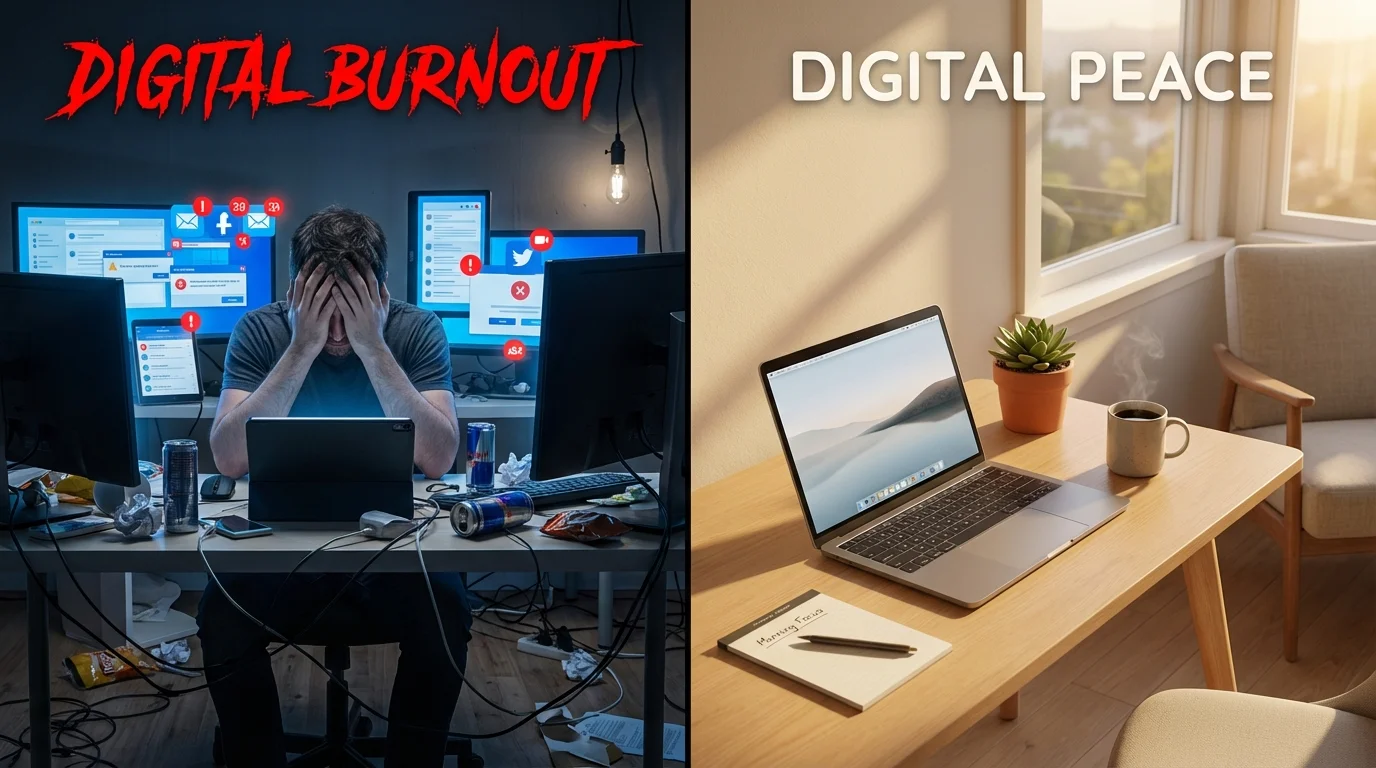
We have all been there. You sit down at your desk, open your laptop, and are immediately greeted by a blinding wall of digital chaos. You have 87 browser tabs open, a desktop littered with files named ‘Untitled-final-final-v2’, and a notification badge on your email icon that reads ‘9,432 unread’. Before you have even typed a single word or started your workday, your heart rate spikes. Your breathing gets shallow. You are already exhausted.
If this sounds familiar, you are not just disorganized—you are suffering from digital burnout. In our hyper-connected modern world, digital hoarding has become the silent killer of productivity, creativity, and mental peace. We treat our digital spaces as infinite storage containers, completely ignoring the massive psychological toll that visual and digital clutter takes on our brains.
The Hidden Cost of Digital Clutter
Digital burnout is not just a buzzword; it is a scientifically documented psychological state. When your screen is filled with disorganized apps, unread messages, and endless tabs, your brain interprets each of these items as an ‘open loop’. According to a psychological principle known as the Zeigarnik Effect, human beings naturally remember uncompleted or interrupted tasks better than completed ones. Every single open browser tab is a subtle reminder of something you haven’t finished yet.
This constant subconscious nagging drains your cognitive battery. Your brain is expending precious energy trying to keep track of the digital mess, leaving you with little to no focus for deep, meaningful work. You start experiencing symptoms like ‘screen apnea’ (subconsciously holding your breath while scrolling), phantom phone vibrations, chronic fatigue, and a severe lack of motivation.
Enter the 10-Minute ‘Tech Declutter’ Rule
When you are already feeling burned out, the idea of spending a whole weekend organizing your digital life sounds like pure torture. You do not have the energy for a massive digital overhaul. That is exactly where the 10-Minute Tech Declutter Rule comes in to save the day.
The concept is incredibly simple, yet ruthlessly effective: You dedicate exactly ten minutes at the end of every single workday to perform a highly structured digital sweep. By time-boxing the activity, you prevent it from becoming an overwhelming chore. Over time, this daily micro-habit compound into massive mental clarity.
The 3-3-4 Method: Your Blueprint for Digital Peace
To make the most out of your ten minutes, the rule is broken down into three specific phases. Grab a timer, set it for 10 minutes, and follow the 3-3-4 method:
- Phase 1: The Browser Triage (3 Minutes) – Your browser is the window to your digital soul. Spend the first three minutes ruthlessly closing tabs. If you haven’t looked at a tab in 24 hours, close it. If it is an article you ‘swear you will read later’, save it to a bookmark manager like Pocket or Notion, and then close the tab. Aim to get down to no more than five essential tabs.
- Phase 2: The Communication Sweep (3 Minutes) – You are not going to answer emails right now; you are just going to organize them. Archive everything in your inbox that doesn’t require an action. Clear your Slack or Teams notifications. The goal is to remove the red notification badges that trigger dopamine and cortisol spikes.
- Phase 3: The Mobile Detox (4 Minutes) – Switch to your smartphone. Delete the blurry photos you took that day. Swipe away your open background apps. More importantly, take this time to delete exactly one app that you haven’t used in a month, or turn off push notifications for an app that constantly distracts you.
Why This Simple Rule Works Like Magic
You might be skeptical. How can just ten minutes of light organizing cure a deep-seated case of digital burnout? The secret lies in the psychology of environmental control and dopamine regulation.
When you complete the 10-Minute Tech Declutter, you are sending a powerful signal to your brain: The workday is over, and I am back in control. By physically closing out tabs and clearing notifications, you are closing those psychological ‘open loops’ created by the Zeigarnik Effect. You are literally freeing up RAM in your human brain.
Furthermore, waking up the next morning and opening a laptop that has a clean desktop, zero unnecessary tabs, and a beautifully managed inbox is an incredible feeling. Instead of starting your day on the defensive—reacting to a mess left by your past self—you start on the offensive, ready to tackle high-priority tasks with laser focus.
Automate Your Digital Life & Reclaim Your Time
Stop drowning in digital busywork. Use this bundle of 100+ AI Assistants to handle your tasks on autopilot so you can finally step away from the screen and cure your burnout.
The Before and After of Digital Minimalism
To truly understand the impact of this daily habit, let us look at the dramatic shift that occurs when you implement the 10-Minute Tech Declutter rule into your lifestyle.
| The Uncluttered Brain (Before) | The Decluttered Brain (After) |
|---|---|
| Morning anxiety upon opening laptop | Calm, focused start to the workday |
| Context-switching 50+ times an hour | Sustained deep work periods |
| High cortisol from red notification badges | Dopamine detoxed, intentional tech use |
| Endless doomscrolling and digital fatigue | More energy for offline hobbies and family |
Taking It to the Next Level: The Weekly Deep Clean
Once you have mastered the daily 10-minute rule, you will naturally start craving even more digital space. This is where you can introduce the ‘Weekly Deep Clean’. Spend 30 minutes every Sunday afternoon doing a larger sweep. Empty your computer’s digital trash bin. Unsubscribe from five email newsletters that you instantly delete anyway. Backup your important files to a cloud drive or external hard drive.
Digital minimalism is not about hating technology. It is about recognizing that technology is a tool, not a master. By intentionally designing your digital environment, you force your devices to serve your goals rather than stealing your attention. Remember, every app on your phone and every website on the internet was designed by teams of behavioral psychologists with one goal: to hijack your attention. Your best defense is a proactive, daily decluttering routine.
Conclusion: Reclaim Your Mental Bandwidth
Digital burnout does not happen overnight. It creeps up on you, one saved bookmark, one unread email, and one downloaded app at a time. Therefore, the cure is not an overnight fix either. But by dedicating just ten minutes a day to the 10-Minute Tech Declutter Rule, you can stop the bleeding. You can regain your mental bandwidth, lower your daily anxiety, and transform your devices back into the helpful tools they were always meant to be. Start today. When your alarm goes off at the end of your workday, set a timer for 10 minutes, and start closing those tabs. Your future self will thank you.
Frequently Asked Questions (FAQ)
What do I do if I am afraid of losing important tabs?
This is known as ‘tab anxiety’. The best solution is to use a session manager extension (like OneTab) or a bookmarking tool (like Pocket or Notion). These tools allow you to save all your open tabs into a clean, searchable list with one click. You can close the tabs knowing they are safely stored, though you will likely find you never actually needed to go back to 90% of them.
When is the best time to do the 10-Minute Tech Declutter?
The absolute best time is at the very end of your workday. Think of it as your ‘shutdown routine’. It provides a psychological boundary between work and personal time, ensuring you do not carry digital stress into your evening.
Will this really cure my digital burnout?
While severe burnout may require broader lifestyle changes, including extended time away from screens and nature therapy, the 10-Minute Rule attacks the root cause of daily micro-stressors. By removing visual chaos, you drastically reduce your cognitive load, which is a massive first step in curing burnout.
How do I handle thousands of unread emails?
Do not try to read them all. If you have over 1,000 unread emails, declare ’email bankruptcy’. Move everything older than 30 days into a folder named ‘Old Inbox Archive’. If it was truly important, the sender will follow up. Start fresh with a zero-inbox mentality moving forward.
What is digital minimalism?
Coined by author Cal Newport, digital minimalism is a philosophy of technology use in which you focus your online time on a small number of carefully selected and optimized activities that strongly support things you value, and then happily miss out on everything else.