
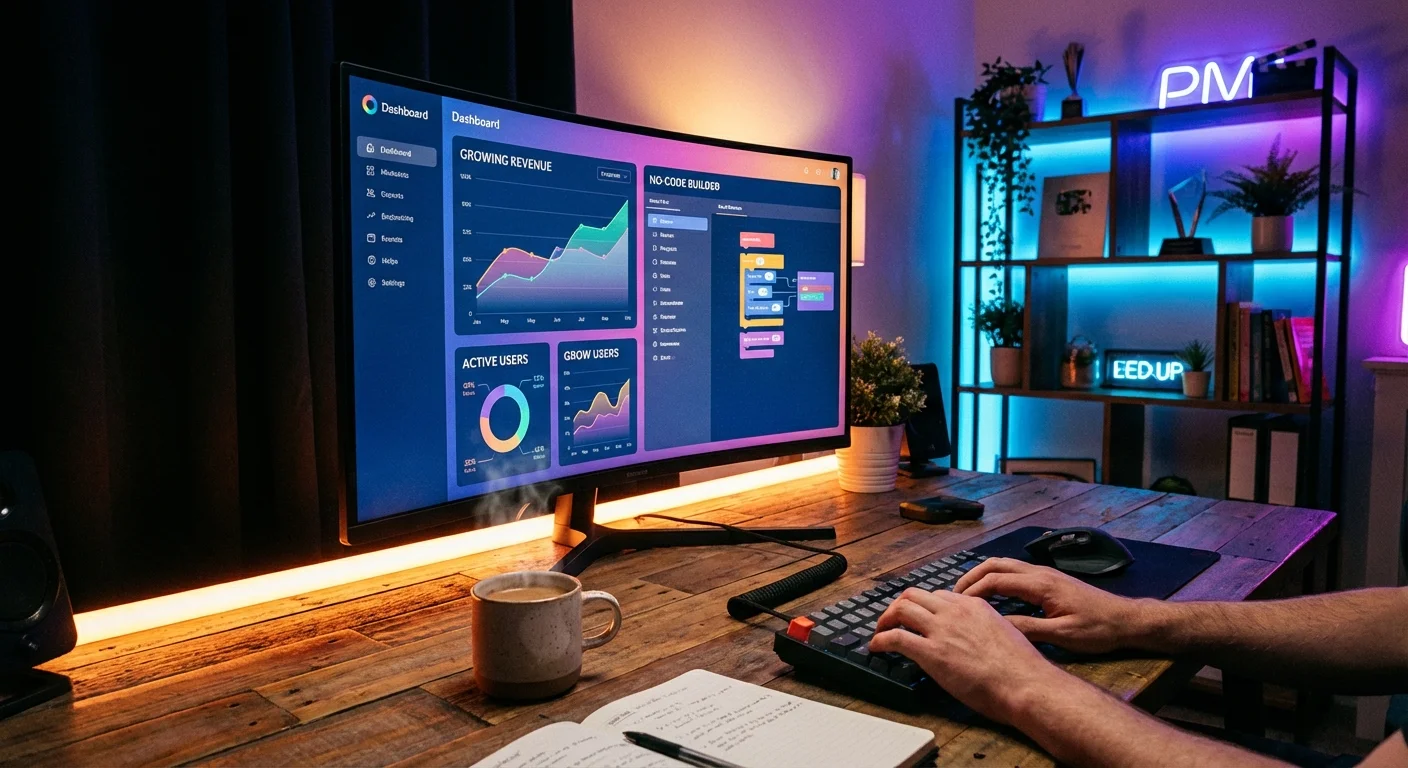
The Dawn of the No-Code Startup Revolution
Imagine waking up on a Monday morning, pouring yourself a fresh cup of coffee, and checking your phone only to see a notification from Stripe: ‘Payment of $15.00 successful.’ You didn’t trade your precious hours for this money. You built a product once, and it is now generating revenue on autopilot. For decades, the ability to build software and generate this kind of scalable passive income was tightly guarded by Silicon Valley elites and developers who spent years mastering complex programming languages. If you had an app idea, you either had to spend $50,000 to hire an agency or spend 12 months learning to code.
Today, those gates have been completely shattered. Welcome to the era of the No-Code Micro-SaaS. Using visually intuitive, drag-and-drop tools, everyday creators, marketers, and side-hustlers are launching profitable software businesses over a single weekend. This blueprint will break down exactly how you can ideate, build, and launch a $500-per-month Micro-SaaS in just 48 hours without writing a single line of code. If you are looking for a legitimate, scalable passive income stream, grab your notepad. Your weekend is about to get very lucrative.
What Exactly is a Micro-SaaS?
Before we dive into the blueprint, we need to define our target. SaaS stands for Software as a Service. Think of massive companies like Slack, Salesforce, or Netflix. A Micro-SaaS operates on the exact same subscription-based business model, but with a highly specialized, laser-focused twist. Instead of trying to build a massive platform for everyone, a Micro-SaaS solves one very specific problem for one very specific niche of people.
For example, a traditional SaaS might be a massive email marketing platform for global enterprises. A Micro-SaaS would be an automated email invoice generator built specifically for freelance dog walkers. By keeping the software small and hyper-focused, you eliminate the need for massive customer support teams, complicated enterprise sales calls, and millions of dollars in venture capital. You can run the entire operation from your laptop, with profit margins often exceeding 90%. Because your overhead is virtually zero, a Micro-SaaS is the perfect vehicle for automated, passive income.
The Psychology of the $500/Month Milestone
Why are we targeting $500 per month? While it might not sound like enough to buy a private island, $500 in recurring monthly revenue is the ultimate proof of concept. It represents a psychological breakthrough. It proves that strangers on the internet are willing to open their wallets and pay for the value you have created. Once you hit $500, scaling to $5,000 is simply a matter of repeating what is already working.
Let us break down the math. To reach $500 per month, you do not need thousands of viral users. You just need:
- 50 users paying $10 per month
- 25 users paying $20 per month
- 10 users paying $50 per month
Finding just 25 people on a planet of 8 billion who find your tool valuable enough to pay $20 a month is an incredibly achievable goal. With the right distribution strategy, you can easily find 25 customers within your first few weeks of launching. Let us dive into the weekend blueprint.
Friday Evening: The Ideation and Validation Phase
Your weekend begins at 6:00 PM on Friday. The biggest mistake new founders make is building a solution and then looking for a problem. We are going to reverse that. We are going to find a bleeding-neck problem and build the exact painkiller for it. Start by auditing your own life, your day job, and your hobbies. What repetitive tasks do you hate doing? What spreadsheets do you use daily that could be turned into a standalone app?
If you cannot find an idea in your own life, head over to niche communities on Reddit, Facebook Groups, or specialized forums. Look for posts where people are complaining about inefficiencies. A great prompt to search within these forums is ‘Does anyone know of a tool that…’ or ‘I spend so much time doing…’ Once you find a recurring pain point, validate it immediately. Do not start building yet. Post a question in that same group: ‘If I built a simple tool that automates X for $15/month, would you use it?’ If you get positive comments and DMs, you have validated your idea. You are ready for Saturday.
Saturday Morning: Choosing Your No-Code Tech Stack
Saturday is build day. The no-code ecosystem is massive, so choosing the right tools is critical to maintaining your speed. You essentially need three components for your Micro-SaaS: a front-end (what the user sees), a back-end (where the data lives), and a monetization layer (how you get paid).
Here is an HTML table outlining a popular beginner-friendly No-Code Stack:
| Component | Tool Recommendation | Why It Works Best |
|---|---|---|
| Front-End Interface | Softr.io or Glide | Extremely fast setup with pre-built templates for user portals. |
| Back-End Database | Airtable | Functions like an Excel spreadsheet but acts as a relational database. |
| Automation Logic | Make (Integromat) | Connects your front-end to thousands of other apps seamlessly. |
| Payment Processing | Stripe | The gold standard for handling recurring SaaS subscriptions globally. |
If you want a more detailed look at the leading front-end builders, here is a quick Markdown comparison:
\n\n| Front-End Builder | Best Use Case | Learning Curve | Pricing Model |\n|—|—|—|—|\n| **Bubble.io** | Complex Logic & Custom SaaS | Steep | From $29/mo |\n| **Glide** | Mobile-First Progressive Web Apps | Very Easy | Free tier available |\n| **Softr** | Web Portals & Marketplaces | Easy | Free tier available |\n| **FlutterFlow** | Native iOS & Android Apps | Moderate | Free tier available |\n\n
By 10:00 AM on Saturday, you should have your accounts created and your basic database structured in Airtable. Think of Airtable as the brain of your app. If you are building a directory of freelance writers, your Airtable will have columns for the writer’s name, portfolio link, and hourly rate. Softr will simply pull that data and display it beautifully on a website.
Saturday Afternoon: Building the Minimum Viable Product (MVP)
Now comes the fun part. Your goal for Saturday afternoon is to build a Minimum Viable Product. The keyword here is Minimum. Your app does not need to look like Apple designed it, and it does not need 50 different features. It only needs to do one thing exceptionally well. If it solves the core problem, users will forgive a clunky button or a basic color scheme.
Connect your Airtable base to Softr. Use Softr’s pre-built blocks to set up a user login page, a dashboard, and a payment gate. With Stripe integrated natively into most no-code tools, you can set up a subscription portal in less than ten minutes. By Saturday night, you should have a functional prototype. Test it yourself. Click every button, create a test user, and run a test transaction using Stripe’s developer mode. If it works, you are ready to launch.
Accelerate Your No-Code SaaS Build
Want to skip the technical hurdles and launch stunning software instantly? Remixable provides a founder-level suite of tools to build, launch, and market your project in record time.
Sunday: The Go-To-Market and Distribution Strategy
You have a working product. Now you need eyeballs. Building a great product is only 20% of the battle; distribution is the other 80%. On Sunday morning, start executing a scrappy, zero-budget marketing campaign. Here is exactly what you need to do:
- Leverage the ‘Build in Public’ Movement: Head over to X (formerly Twitter) and LinkedIn. Share a screenshot of what you just built. Tell the story of your weekend. People love underdogs and transparent journeys. Use tags like #buildinpublic and #nocode.
- Return to Your Validation Channels: Go back to those Reddit threads or Facebook groups where you initially validated the idea. Comment on your original post saying, ‘Hey everyone, I spent the weekend building this based on your feedback. Here is a link, the first 10 users get a lifetime discount.’
- Launch on Product Hunt: Create a compelling listing on Product Hunt. Prepare some attractive screenshots, write an engaging maker’s comment explaining the problem you are solving, and invite the community to try it out.
- Cold Email Outreach: If your app serves a specific B2B niche (e.g., SEO agencies), find 50 agency owners on LinkedIn and send them a brief, personalized message offering free access in exchange for honest feedback.
Scaling from $0 to $500 and Beyond
Getting your first paying subscriber is an exhilarating feeling. It is the ultimate validation. Once you hit that first user, your goal shifts from building to talking to customers. Ask them why they bought it. Ask them what features they want next. Their feedback will guide your development roadmap. As you refine the product, churn (users canceling) will drop, and your monthly recurring revenue (MRR) will stack up.
Reaching $500 a month might take a weekend of building and three weeks of relentless marketing, but once you arrive, you have created a digital asset. From there, you can scale to $1,000, hire a virtual assistant for support, or even sell the Micro-SaaS on platforms like Acquire.com for a 30x to 40x multiple. The no-code revolution has democratized software creation. The only thing standing between you and a profitable Micro-SaaS is 48 hours of focused work. Your weekend starts now.
Frequently Asked Questions (FAQ)
Do I really need zero technical knowledge to start?
Yes. If you can use Microsoft Excel or create a PowerPoint presentation, you can build a no-code Micro-SaaS. Tools like Bubble and Softr use drag-and-drop visual interfaces. The logic is built using simple ‘If This, Then That’ statements rather than complex syntax, making it highly accessible for beginners.
How much does it cost to launch a No-Code SaaS?
You can legitimately launch for under $50. Most no-code tools offer generous free tiers. You might need to buy a custom domain name (around $10/year) and upgrade to a basic paid tier on your front-end builder once you connect your domain or need to accept payments (usually $20-$40/month). Your overhead is incredibly low compared to traditional businesses.
What if someone steals my app idea?Ideas are cheap; execution is everything. Even if someone copies your feature set, they cannot copy your unique distribution strategy, your customer service, or the specific community you have cultivated. In the Micro-SaaS world, being close to your customers is your ultimate competitive moat. Do not let the fear of copycats stop you from launching.
Can a No-Code app handle thousands of users?
Absolutely. Modern no-code platforms are built on top of robust infrastructures like AWS (Amazon Web Services). Platforms like Bubble and Xano can scale to handle hundreds of thousands of users. If your app becomes so massive that you outgrow a no-code backend, you will have plenty of revenue to hire a team of developers to build a custom solution.
How do I handle customer support if I have a full-time job?
Automation is your best friend. Set up a comprehensive FAQ page, create short screen-recording tutorials using tools like Loom, and integrate a basic AI chatbot to handle common queries. For complex issues, set an expectation that email support takes 24 hours. Because you are solving a very narrow problem, support tickets are usually minimal.