
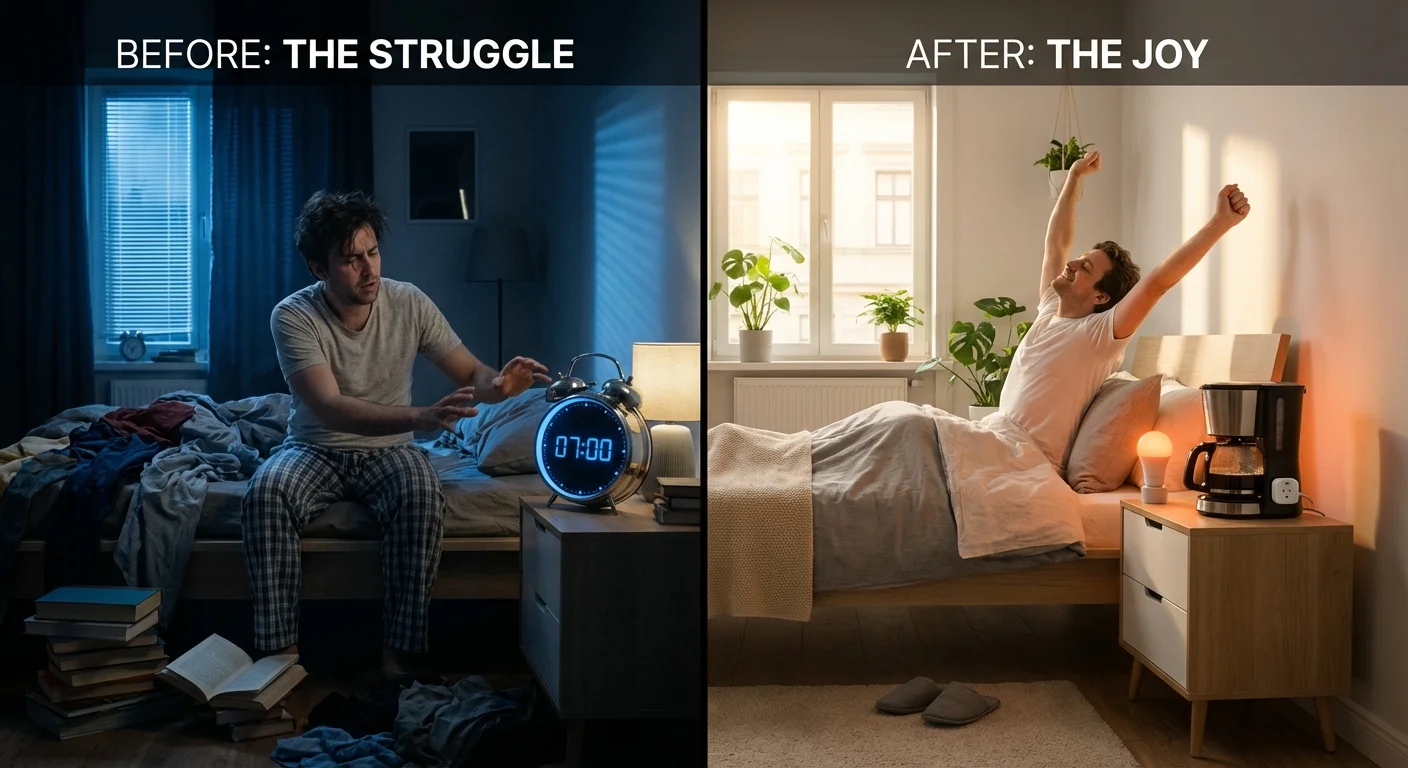
For the first 28 years of my life, mornings were my absolute nemesis. The shrill, panic-inducing shriek of my smartphone alarm was the daily starting pistol for a chaotic race against the clock. I would hit snooze at least three times, drag my exhausted body out from under the warm covers, and stumble around in the dark trying to find my clothes. By the time I finally left the house, my cortisol levels were through the roof, and my energy was already depleted. I was suffering from severe sleep inertia—that groggy, disoriented feeling that hangs over you when you are jolted awake during a deep sleep cycle.
I tried everything the internet gurus suggested. I read about the 5 AM Club. I tried drinking a liter of water immediately upon waking. I even tried putting my phone across the room to force myself out of bed, but I would just zombie-walk over, turn it off, and collapse back into the mattress. Willpower alone was failing me miserably. I realized that if I wanted to fix my mornings, I couldn’t rely on sheer mental fortitude. I needed to fundamentally alter my environment. That is when a late-night internet rabbit hole led me to a brilliantly simple, automated solution. I completely eliminated morning friction with a $40 smart home upgrade that literally pulls me out of bed without a single drop of willpower required.
The Core Problem With Traditional Mornings
Before we dive into the $40 fix, we have to understand why traditional waking methods are so flawed. Human beings did not evolve to wake up to a sudden, blaring klaxon in pitch darkness. For thousands of years, our circadian rhythms were naturally regulated by the gradual rising of the sun and the slow warming of the ambient temperature. When you use a traditional alarm clock in a dark room, you are fighting millions of years of evolutionary biology.
Furthermore, early mornings are when your willpower reserves are at their absolute lowest. Every decision you have to make—whether to get up, whether to turn on the light, whether to make coffee, whether to put on a sweater—acts as ‘friction’. When friction is high, your brain defaults to the easiest possible action, which is staying under the warm blankets. To fix my mornings, I realized I needed to eliminate this friction entirely. I needed my environment to wake me up gently, systematically, and automatically.
The $40 Smart Home Toolkit
You might think that automating your morning requires a massive investment in high-end smart home ecosystems, expensive hubs, or luxury appliances. That is a myth. All it took to revolutionize my daily routine was exactly $40 spent on a few basic, entry-level smart gadgets. Here is exactly what I purchased:
| Item | Purpose | Approximate Cost |
|---|---|---|
| 2-Pack Wi-Fi Smart Plugs | Automating the coffee maker and space heater | $20.00 |
| 1 Wi-Fi Color Smart Bulb | Creating an artificial sunrise effect in my bedroom lamp | $15.00 |
| NFC Tags (Optional 10-pack) | Tapping my phone to instantly trigger ‘Morning Mode’ | $5.00 |
| Total Investment: | $40.00 | |
With these simple items connected to the free smart home apps on my phone, I set out to build the ultimate ‘Gentle Wake’ automation. The goal was to manipulate light, temperature, and scent to naturally draw me out of my slumber.
Building The ‘Gentle Wake’ Automation
Here is the exact timeline of the automation sequence I programmed into my smartphone. I set my desired wake-up time for 6:30 AM, but the routine actually begins much earlier. By staggering the environmental changes, I trick my brain into thinking it is waking up naturally.
Phase 1: The Temperature Shift (6:00 AM)
One of the main reasons getting out of bed is so difficult is the stark contrast between the warm cocoon of your blankets and the freezing air of your bedroom. To combat this, I plugged a basic, cheap space heater into one of the smart plugs. At exactly 6:00 AM, the smart plug clicks on, sending power to the heater. Over the next 30 minutes, my bedroom gradually warms up to a comfortable 72 degrees. By the time I need to throw the covers off, the physical shock of the cold air is completely gone.
Phase 2: The Artificial Sunrise (6:10 AM)
Ten minutes after the heater kicks on, the smart bulb in my bedside lamp activates. However, it does not just turn on at full brightness—that would be too jarring. Instead, I programmed it to start at 1% brightness using a deep, warm amber color. Over the course of 20 minutes, the bulb slowly transitions from dim amber to a bright, cool white, mimicking the natural progression of a sunrise. This slow introduction of light filters through my closed eyelids, signaling to my brain to suppress melatonin production and begin ramping up cortisol. By the time my actual alarm goes off, I am already resting in a state of very light sleep.
Phase 3: The Scent of Motivation (6:20 AM)
At 6:20 AM, my second smart plug activates in the kitchen. I have an old, ‘dumb’ drip coffee maker plugged into it. Before I go to bed every night, I load it with water and fresh coffee grounds, and I flip its physical switch to the ‘ON’ position. Because the smart plug acts as the gatekeeper for the power, nothing happens until 6:20 AM. When the power flows, the coffee starts brewing. Within five minutes, the rich, intoxicating scent of fresh coffee wafts from the kitchen into my bedroom. Smell is one of our most powerful senses tied to memory and motivation. The scent alone gives my brain a reason to get up.
Phase 4: The Final Nudge (6:30 AM)
Finally, at 6:30 AM, a soft, acoustic playlist begins playing from my phone, slowly increasing in volume. Because my room is warm, my brain is already stimulated by light, and the smell of coffee is calling my name, I no longer experience the overwhelming urge to hit snooze. I simply stretch, turn off the music, and walk into the kitchen to a fresh cup of coffee waiting for me.
Supercharge Your Morning Mental Focus
Now that your home is automated to physically wake you up, optimize your brainwaves for a perfectly productive morning with this 7-minute audio breakthrough.
The Psychological Shift of Automated Evenings
An unexpected benefit of this morning routine was how it completely changed my evenings. In order for my morning automation to work, I have to ‘prep’ the environment the night before. I have to fill the coffee maker, ensure the heater switch is on, and set my phone on the charger. This simple 3-minute evening routine acts as a psychological boundary. It signals to my brain that the active day is officially over and it is time to wind down. By preparing the physical space for tomorrow, I am giving a gift to my future self. The anxiety of ‘what do I need to do tomorrow’ evaporates because the crucial first hour is entirely out of my hands. It is governed by a microchip.
How You Can Replicate This Today
If you are struggling with your mornings, I cannot recommend this $40 upgrade enough. You do not need to be a tech genius to set it up. Whether you use Amazon Alexa, Google Home, or Apple HomeKit, the process is practically identical. You simply plug the devices into the wall, connect them to your Wi-Fi using the manufacturer’s app, and look for the ‘Routines’ or ‘Automations’ tab. From there, you just create a time-based trigger (e.g., ‘At 6:00 AM’) and select the actions you want your devices to take. It takes less than 15 minutes to configure, but it pays dividends every single day of your life.
By offloading the heavy lifting of waking up to cheap, accessible technology, I gained back roughly an hour of my day that used to be lost to snoozing and complaining. I am more productive, my mood is infinitely better, and I actually look forward to the gentle, systematic way my home nudges me awake.
Frequently Asked Questions (FAQ)
Do I need a smart speaker like an Echo or Google Nest to make this work?
No! While smart speakers are great for voice controls, they are completely unnecessary for time-based automations. The smart plugs and bulbs connect directly to your home Wi-Fi and can be programmed entirely through their respective smartphone apps.
What if my Wi-Fi goes down in the middle of the night?
This is a valid concern. If your Wi-Fi drops, cloud-dependent automations might fail. For this reason, I always recommend keeping a standard phone alarm set for your absolute latest wake-up time as a fail-safe. However, many modern smart home hubs (if you choose to upgrade later) process automations locally, meaning they work even without the internet.
Can I use any coffee maker for the smart plug trick?
You specifically need a ‘dumb’ coffee maker with a physical analog switch or a button that stays toggled down. If your coffee maker has a digital screen or requires you to press a soft button every time you want to brew, a smart plug will only turn on the power to the machine, but it will not start the brewing process.
Does the artificial sunrise really make a difference compared to just turning on a lamp?
Absolutely. The gradual increase in light intensity is the key. Flipping a switch from dark to 100% brightness causes an immediate shock to your system, which can trigger irritability and eye strain. A gradual fade over 20-30 minutes mimics natural biology, halting melatonin production smoothly.
Is it safe to leave a space heater plugged into a smart plug?
You must check the wattage rating of your space heater and the maximum load of your smart plug. Most basic smart plugs are rated for 15 Amps (roughly 1800 Watts). If your heater draws more than this, it can be a fire hazard. Always ensure your smart plug is heavily rated, do not use extension cords, and keep the heater far away from any flammable materials like blankets or curtains.